

It is extraordinary how complex the waveforms generated can be with just 12 chromatic notes. Using pure sine waves I tried it myself. Below is a table of the Frequencies of the Sine Waves used to create serial dodecaphonic chords. Musicians familiar with serial composition will know that all 12 notes of the chromatic scale are used in strict order knowns as a “note row” A technique originally devises by Arnold Schoenberg. Later the idea of a single note comprising of whole “note row” was devised in some of Stockhausen electronic music.
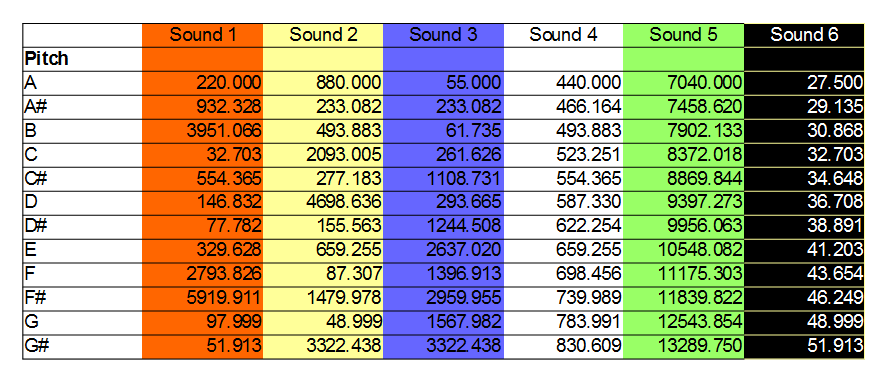
In my experiment with dodecaphonic chords uses some the individual pitches in Sound 5 and Sound 6 are inaudible to many human ears, but combined, can be heard as minute vibrations in the ear as a result of interference patterns between one or more pitches (see table above showing frequencies in Hz). I deliberately chose clusters in extreme regions of the audible spectrum has part of the experiment. Open chords across a wide region of frequencies can often sound like machines you could imagine in a factory. There are a lot of options to explore with construction of sounds with this serial technique.
I have used just 6 separate sound clusters to create this short piece called the “Ipcress File Addendum: Dodecaphonic clusters”.
 VicBerry.net